
About us
Who We Are
Restart Dogs CIC is a Community Interest Company delivering canine assisted rehabilitation programmes within prisons and young offenders institutions in England and Wales. Founded in 2019, we are the only organisation in England delivering a full-time, professionally led, CPD-accredited assistance dog training programme in adult custodial settings.
The programme trains people in custody to raise and train assistance dogs for individuals with disabilities and Armed Forces veterans with complex needs. Our trained dogs are placed through Bravehound, a Scottish charity and full member of both Assistance Dogs International and Assistance Dogs UK, and go on to transform the lives of the people they support.
We are a Full Member of Animal Assisted Intervention International (AASI), the global professional body setting standards for animal assisted intervention practice. The programme is led by ABTC-accredited animal behaviourists, ensuring that both human participants and the dogs in our care receive the highest standard of professional support.
Our History
2019: Restart Dogs launched at HMYOI Werrington, a young offenders institution in Staffordshire, working with young people aged 15 to 18. The programme demonstrated that the model could work within the unique constraints of a custodial environment, delivering measurable outcomes for participants while producing dogs suitable for assistance dog training.
2021: The programme expanded to HMP Dovegate, a Category B adult prison in Staffordshire operated by Serco. This was the first adult men's prison in England to run a full-time canine assisted rehabilitation programme of this kind.
2023: Restart Dogs began operating at HMP Fosse Way, a new Category C resettlement prison in Leicester. The programme continues to develop and expand, with active discussions underway with additional prison operators across England and Wales.
2024: Restart Dogs was awarded the Mirror Pet Award for Inspiration, recognised at the national awards ceremony for the programme's dual impact on participants in custody and the people who receive trained assistance dogs. An independent MSc research study evaluating the programme was conducted at Staffordshire University, supervised by Professor James Treadwell.
2025: Restart Dogs converted from a private limited company to a Community Interest Company (CIC), formalising the organisation's social mission. The programme has now placed 12 assistance dogs, with further dogs in training.
Our Approach
Everything we do is grounded in evidence-based, positive reinforcement methodology. This applies equally to how we train the dogs and how we support the people on the programme.
The principle is simple: punishment suppresses unwanted behaviour, but only positive reinforcement builds new neural pathways and creates lasting behavioural change. This is as true for people as it is for dogs. Learners on the programme experience this firsthand as they see their dogs respond to patience, consistency, and kindness rather than force or confrontation.
Animal welfare is central to every decision. The programme follows the IAHAIO White Paper on Animal Assisted Interventions (2014/2018) and the AASI Standards of Practice. The dogs' training, socialisation, health, and emotional wellbeing are monitored daily by qualified animal behaviour professionals.
CIC Status and Governance
Restart Dogs CIC is a Community Interest Company registered in England, meaning it exists to benefit the community rather than to generate private profit. The CIC structure ensures that the organisation's assets and activities are permanently directed towards its social mission: delivering rehabilitation through canine assisted interventions and producing assistance dogs for people who need them.
Rachel Trafford is the founder and Programme Development Lead. She is an ABTC-accredited Animal Behaviourist with extensive experience in canine behaviour, animal welfare, and the design and delivery of animal assisted interventions in custodial and community settings.
Restart Dogs is supported by Taking the Lead, a registered charity (Charity Number 1205906) established to support the wider mission of canine assisted rehabilitation and related community programmes.
A Day on the Programme
A typical day on the Restart Dogs programme follows a carefully structured routine designed around the needs of the dogs and the learning objectives of participants:
08:00 Dogs arrive in the classroom. They settle into their areas with a chew and time to rest.
09:00 Learners arrive. The session begins with a check-in: how are the dogs, how are the learners, any observations from the foster families overnight.
09:15 First outdoor training and play session. Learners work on specific training goals set from the previous day.
09:45 Dogs return for settling practice. Learners record observations and training data, then begin theory work while the dogs rest.
10:45 Dogs receive enrichment (stuffed Kongs, chews, puzzle feeders).
11:00 Short play session before undisturbed sleep time, an important component of puppy development.
13:30 Learners return from lunch. They review the morning's training data and adjust criteria for afternoon sessions, with emphasis on errorless learning and environmental management.
13:45 Afternoon training session.
14:30 Data recording and theory discussion.
14:45 Dogs rest. Bonding time including reading to the dogs and Tellington TTouch massage techniques.
16:00 Dogs are collected by their foster families and go home for the evening and weekend.


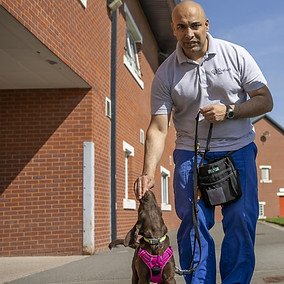


A Day in the Life of a Restart Puppy...
08:00 Dogs arrive in the classroom. They settle into their areas with a chew and time to rest.
09:00 Learners arrive. The session begins with a check-in:how are the dogs, how are the learners, any observations from the foster families overnight.
09:15 First training and play session outdoors.
09:45 Dogs return to settle. Learners record observations from the training session and begin theory work while the dogs rest.
10:45 Enrichment: stuffed Kongs and chews.
11:00 Short play session before undisturbed sleep time. Sleep is protected because it matters for puppy development and welfare.
13:30 Afternoon session. Learners review their training plans, adjusting criteria based on the morning’s data. The emphasis is on errorless learning and managing the environment for success.
13:45 Afternoon training session.
14:30 Data recording from training sessions.
14:45 Rest and bonding time. Learners read to the dogs and use Tellington TTouch techniques.
16:00 Dogs are collected by their foster families and go home.